Additív gyártás integrálása az oktatásba az Ipar 4.0 és Minőség 4.0 szemléletében
DOI:
https://doi.org/10.12700/bk.2026.8.1.267Kulcsszavak:
additív gyártás, szabadlabor, biztonság, kockázatfelmérésAbsztrakt
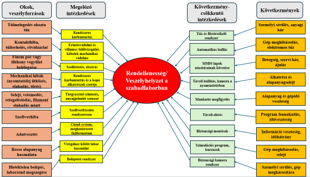
Az additív gyártási technológiák, különösen a 3D-nyomtatás, elengedhetetlenek az Ipar 4.0 és a Minőség 4.0 keretrendszereknek megfelelő projektalapú műszaki oktatás elősegítéséhez. A cikk központi eleme egy felügyelet nélküli működésre tervezett, 3D-nyomtatás számára kialakított nyílt laboratórium koncepciójának bemutatása, amely kifejezetten a hallgatók önállóságának, az együttműködésen alapuló tanulásnak és a digitális kompetenciák fejlesztésének elősegítését célozza. A kutatás során felmérést végeztünk a hallgatói elvárásokról, amelynek eredményei alapján funkcionális, informatikai és szervezeti javaslatokat határoztunk meg. A laboratórium biztonságos működésének értékeléséhez három kockázatelemzési módszert – GYELV-elemzést, kockázati mátrixot és csokornyakkendő elemzést – alkalmaztunk. Az elemzés rávilágított a legkritikusabb műszaki, elektromos, munkavédelmi, informatikai és felhasználói veszélyekre, valamint azok enyhítésére és ellenőrzésére szolgáló stratégiákra. Az eredmények azt mutatják, hogy a felügyelet nélküli 3D-nyomtató laboratórium nem alacsony kockázatú környezet, azonban megfelelő ellenőrzések és technikai segítségnyújtás mellett biztonságosan üzemeltethető. A kutatás kihangsúlyozza, hogy a digitalizáció, az érzékelőhálózatok, a távfelügyelet és az adatközpontú működés alkalmazása jelentősen javítja a laboratórium megbízhatóságát. A javasolt modell megfelel az Ipar 4.0 és a Minőség 4.0 követelményeinek, és kiválóan alkalmas a projektalapú műszaki felsőoktatásra.
Hivatkozások
ISO/ASTM 52900:2021 Additive manufacturing — General principles — Fundamentals and vocabulary
M. R. Khosravani & T. Reinicke: On the environmental impacts of 3D printing technology, Applied Materials Today, Volume 20, 2020, 100689, ISSN 2352-9407, https://doi.org/10.1016/j.apmt.2020.100689
M. Sony, S. Naik: Key ingredients for evaluating Industry 4.0 readiness for organizations: a literature review, Benchmarking: An International Journal, Vol. 27 No. 7, 2020. pp. 2213–2232, doi: https://doi.org/10.1108/BIJ-09-2018-0284
P. Guo, N.Saab, L. S. Post, W. Admiraal: A review of project-based learning in higher education: Student outcomes and measures, International Journal of Educational Research, Volume 102, 2020, 101586, ISSN 0883-0355, https://doi.org/10.1016/j.ijer.2020.101586
Blumenfeld, P. C., Soloway, E., Marx, R. W., Krajcik, J. S., Guz-dial, M., & Palincsar, A.: Motivating Project-Based Learning: Sustaining the Doing, Supporting the Learning, Educational Psychologist, 1991., 26(3–4), 369–398. https://doi.org/10.1080/00461520.1991.9653139
P. Jain, T.Bhardwaj: Additive Manufacturing: A Comprehensive Review, International Journal of Engineering Research in Mecha-nical and Civil Engineering (IJERMCE), Vol 9, Issue 7, July 2022.
A. Jandyal, I. Chaturvedi, I. Wazir, A. Raina, M. I. Ul Haq: 3D printing – A review of processes, materials and applications in industry 4.0, Sustainable Operations and Computers, Volume 3, 2022, pp. 33-42, ISSN 2666-4127, https://doi.org/10.1016/j.susoc.2021.09.004
D. Acierno & A. Patti, Antonella: Fused Deposition Modelling (FDM) of Thermoplastic-Based Filaments: Process and Rheologi-cal Properties — An Overview. Materials. 16., 2023. 7664. https://doi.org/10.3390/ma16247664
Wang, TI., Chang, PC: The Effect of 635 Brainstorming on the Creativity of Programming Design. In: Wu, TT., Gennari, R., Huang, YM., Xie, H., Cao, Y. (eds) Emerging Technologies for Education. SETE 2016. Lecture Notes in Computer Science, vol 10108. Springer, Cham. https://doi.org/10.1007/978-3-319-52836-6_6
R. Puyt & F. Lie & C. Wilderom, Celeste: The origins of SWOT analysis. Long Range Planning. (2023) DOI: 10.1016/j.lrp.2023.102304
ISO/IEC 31010:2019 Risk management - Risk assessment tech-niques
A. de Ruijter, F. Guldenmund: The bowtie method: A review, Safety Science, Volume 88, 2016, pp. 211-218, ISSN 0925-7535, https://doi.org/10.1016/j.ssci.2016.03.001
##submission.downloads##
Megjelent
Hogyan kell idézni
Folyóirat szám
Rovat
License
Copyright (c) 2026 Brigitta Hopka, Gabriella Farkas

This work is licensed under a Creative Commons Attribution-NonCommercial-NoDerivatives 4.0 International License.